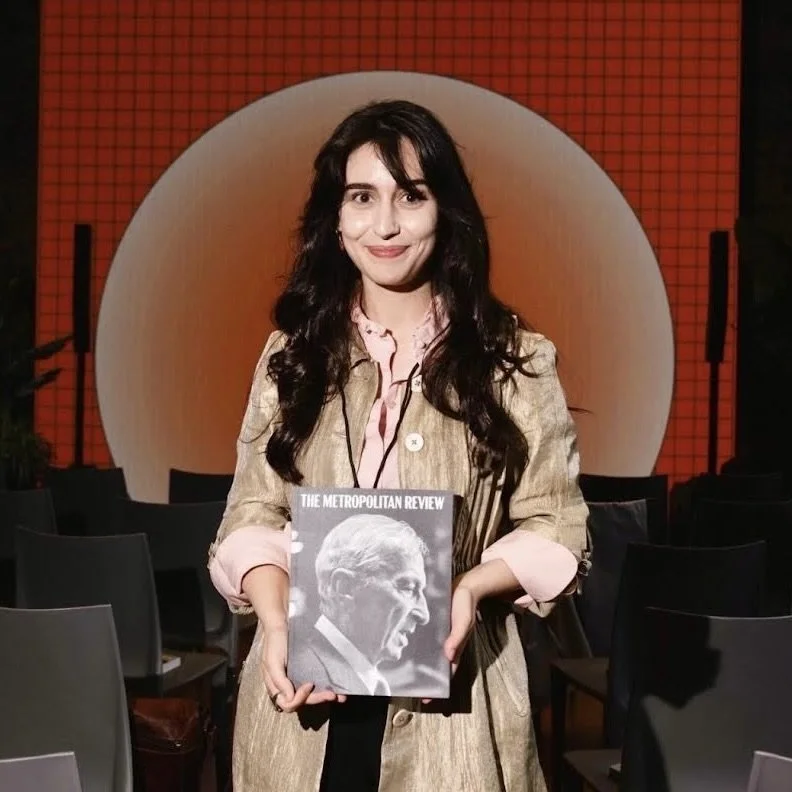
Lou Bahet is Co-President and Executive Editor at The Metropolitan Review, a books and culture review magazine she co-founded with Ross Barkan and David Roberts in 2025. She is a three-time Fiction and Non-Fiction Fellow of the Writers’ Institute and a recent Literary Fellow-in-Residence at the Bogliasco Center, situated on the Italian Riviera. Educated in the San Francisco Bay Area, London, and New York, Lou holds a B.A. in Comparative Literature from NYU. She is at work on a memoir about family, homecomings, and object histories, set in a New York apartment building. She also writes poetry and is on Substack.
“The Last Literary Lion of New York, Gay Talese: The Editors’ Interview.” Ross Barkan & Lou Bahet. The Metropolitan Review. October 2025.
It is the rarest of gifts to have lived long enough to survey both a life and a century in its greatest breadth; even rarer still to be both an active participant and shaper of the currents, to have walked alongside the titans of the age and brought them, somehow, to fuller life. . . . This is shorthand for understanding Gay Talese. . . . On a warm afternoon in August, we had the pleasure of visiting Talese to conduct an interview that lasted nearly three hours and ranged over every topic conceivable: Sinatra, Trump, boxing, adultery, the writing life, the nudist life, the importance of dressing well. . . . Talese is strikingly undiminished, both regal and sprightly, not merely a bridge to the glittering midcentury but a full embodiment of its promise.
“Getting Even: Talese’s Long-Lost New York Fiction.” Gay Talese. The Metropolitan Review. November 2025.
You may have noticed during our interview that Talese made a brief, passing mention of a lone short story published in Mademoiselle that he wrote in 1966, “Getting Even,” his first and last foray into fiction. That detail beguiled our Executive Editor, Lou Bahet, who began to wonder about the fate of this nearly six-decade-old magazine short story. She started searching for the piece, scouring periodical archives and databases, but found that it was lost to time. There was little public record of its existence, it had never been anthologized, and even the precise issue date of its publication proved elusive. Finally, buried within a web archive of 1960s women’s lifestyle magazines, she found a crude digital scan of “Getting Even” in Mademoiselle’s May 1967 summer beauty issue. She printed it out and read it by candlelight at a lonesome Midtown bar. When she put down the pages after midnight, she felt certain that “Getting Even” was nothing less than a forgotten masterpiece of noirish city writing.
Featured Media
“The Last Untamed Writer In America.” The Wall Street Journal. Alexander Nazaryan. August 2025.
His struggles to see “A Table for Fortune” into print were the subject of an 11,000-word article by Alexander Sorondo published in March by the Metropolitan Review, a new literary journal. Despite its length, executive editor Lou Bahet said, it is the second-most-read article the site has published. In her view, that is evidence of Vollmann’s relevance, and of a hunger among many readers for serious writing.
“A lot of publishers and outlets don’t know how to meet the real demand for literary culture that clearly exists,” Bahet told me. “If someone who is regarded as a genius has to wage an epic battle to publish at this stage in his career, then what that spells for the rest of us is really concerning."
Featured Media
“Inside the Reviewnaissance: A new generation tries its hand at publishing “the unusual, the difficult, the lengthy.” Columbia Journalism Review. Carolina Abbott Galvão. February 2026.
Recent years have seen the rise of a number of niche publications covering topics ranging from business to fine art to cemeteries: the New York Review of Finance, the Metropolitan Review, the Whitney Review of New Writing. . . . Chloe Wyma, NYRA’s deputy editor, told me that we’re living in the “reviewnaissance.” That is a notable statement in part because the past few years have not been kind to critics. The Associated Press stopped publishing book reviews last year; Vanity Fair fired its chief critic; the New York Times reassigned four arts critics. Most recently, amid a round of mass layoffs, the Washington Post shut down its books section. And yet there’s a world where the art of the review is alive and well. . . . If the review sections of newspapers are closing down, there’s a sense that this moment could make room for a meatier, weirder kind of criticism.
Featured Media
“The Metropolitan Review Wants You to Experience the Literary Life, IRL.” The Village Voice. R.C. Baker. September 2025.
Are you a novelist? Hoping to be one? Or do you just want to argue over whatever the hell a novel might be in 2025? Well here’s your chance to ditch all those nattering URLs for an IRL meetup with the staff, subscribers, and admirers of The Metropolitan Review, the audacious, new — relatively — lit mag that looks at all facets of the Word.
Featured Media
“The Sad Young Literary Man Is Alive and Well on Substack.” Vox. Constance Grady. August 2025.
[T]he kind of publications that used to host such daring, strange, and thrilling speech no longer do, and the Metropolitan Review is stepping into the breach. [Barkan] argues somewhat optimistically that the Metropolitan Review, which has around 22,000 subscribers, is “one of the more widely read literary magazines in America.”
The combined mythologies of the Metropolitan Review and Substack summer have given these writers the beginnings of a cohesive self-identity. The world they’ve built with that identity is, interestingly, a bit of a throwback.
Illustration by Ava.